
Can We Prove Content Marketing Works In Candidate Attraction?

A few years ago, I gave a talk at a job board conference about the value of content and employer storytelling.
At the time, we'd invested heavily in creating useful content for nurses and care professionals. Instead of relying primarily on paid traffic, we built a library of first-hand career advice, real life video stories, salary guides, employer profiles, interview tips and professional development content.
Nurses.co.uk’s audience grew from around 35,000 users per month to 1.2 million users per year. More importantly, we dramatically reduced our reliance on paid traffic. Eventually, we stopped buying traffic from aggregators completely. We were receiving roughly the same volume of applications, but increasingly those applications were coming from people who had found us organically.
Then, during the questions, Lee Biggins, CEO of CV-Library, asked something that has resonated since:
"How do you know those applications came from the content, rather than people simply applying directly to the jobs?"
It was a good question. And one that has stayed with me. I'll come back to my answer at the end.
Correlation Isn't Causation
As marketers, we love dashboards and metrics and data. We want to attribute every click, every visitor and every application to a specific campaign. We want to prove that Article A generated Job Application B.
The reality is that recruitment doesn't work like that. Imagine someone watches my Q+A with Caitlin about becoming a nurse assessor for PFAS today. A month later they might return to compare salaries. A few weeks after that they might browse our employer’s profiles, or see one of our posts on LinkedIn.
Finally, three months later, they search Google for nursing jobs, recognise our brand, click to search our jobs and submit an application.
Which interaction deserves the credit, even if we could accurately track all of that behaviour?
The honest answer is: probably all of them. But we don’t know.
Measuring What You Can
That doesn't mean content can't be measured. It means we have to be realistic about what measurement can and can't tell us.
We could see organic search traffic increasing very significantly.
And we were thrilled when we moved from paying for 35,000 users a month to paying nothing and trebling the size of the audience - while application levels were sustained.
These were real and measurable metrics. Were they KPIs that were clearly linked to job application quality and volume? You couldn't argue that with certainty.
Instinct tells us that passive candidates do not suddenly decide to start job hunting just because they’ve interacted with a useful pay calculator.
But, we can dig into our Google search tools and see branded searches increasing. And we can see our job landing pages climbing the search rankings.
These signals strengthen the case for content, while none prove, of course, that a specific article generates a specific application.
Building An Audience Instead Of Renting One
There was another reason we invested so heavily in content.
At the time, a significant proportion of our traffic came from paid programmatic job aggregators. They were valuable partners, but ultimately we were renting an audience.
The commercial objective of those platforms wasn't identical to ours. Their role was to generate traffic. Our role was to help employers attract the right (quality and even qualified) candidates.
By investing in organic search, we built a direct relationship with our audience and, crucially, an audience that arrived at our site after conducting a specific, high-intentioned query.
Organic search tends to bring people with stronger intent. Someone searching "ICU nurse salary", "care assistant interview questions", “mental health nurse jobs in beckton” or "what's it like to work for Bupa?" has already told you what they want.
That creates a very different relationship from simply buying clicks.
Good Content Is Leveraged In The Age Of Generative Search
Furthermore, as our AI search visibility performance ticks up in Google Search Console, I infer that we’re sending the right signals to LLMs that we are authoritative and trusted. AI search agents love structure and trust and depth.
For fifteen years we unknowingly built a website optimised for the AI era. Rich, structured, original content; topical authority; internal linking; employer stories; salary guides; FAQs; videos; deep landing pages. We built it for people, but it turns out AI systems value exactly the same characteristics.
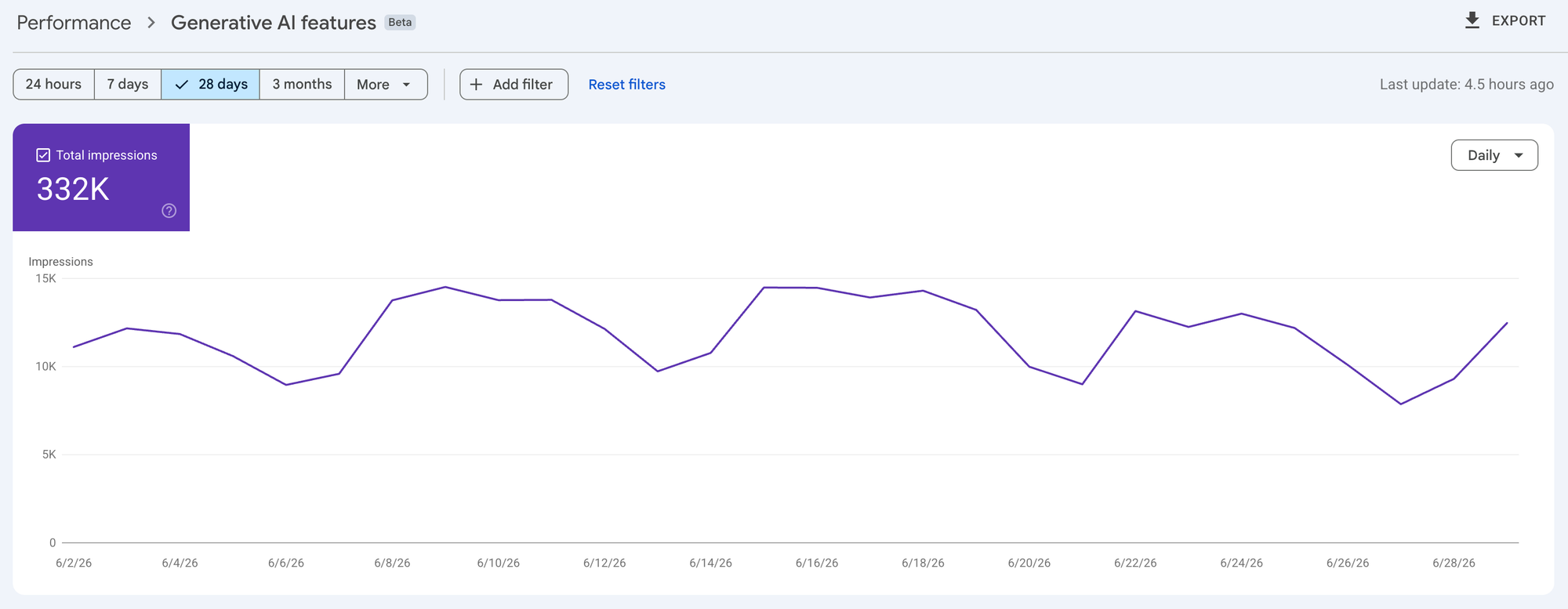
Our move to content means that users find us because they are actively searching for information about careers, employers and jobs, and not because an intermediary has sent them to us.
Not Every Visitor Is Looking For A Job (yet)
It's important to acknowledge something else: not all of our users are active jobseekers.
Many visit because they want career advice, salary information, CPD guidance or employer research.
Some may never have applied for a job through us. And that's perfectly fine. Our goal isn't just to capture demand. It is to build trust before demand existed.
People don't usually decide to change jobs overnight. They research. They learn. They compare employers. They come back. They ask questions. They return months later when the timing is right.
Years ago, we believed that if we could become a trusted destination throughout that journey, we'd be the natural place they returned to when they were finally ready to apply.
The Authority Effect
I also have another hypothesis. It’s not revelatory - and it’s been embedded into the very core of good SEO for years. We just have a handy acronym for it now: EEAT - experience, expertise, authoritativeness and trust. (Note that “keyword stuffing” is not covered in that handy acronym ;)
It’s widely held that Google's algorithms reward websites that demonstrate genuine EEAT. And, again it turns out, LLMs love it too (it's why they make a bee-line for Reddit so often).
When you consistently publish genuinely useful content around a subject (in our case nursing careers and jobs, employers and professional development) you don't just improve the visibility of those articles, you strengthen the authority of the entire domain.
The belief has always been (and I hold this as a north star) that quality content raises the visibility of related pages too. The fabled “a rising tide lifts all boats” analogy.
I can’t prove this with metrics, but it’s allowed my business to survive while a number of competitors who remained heavily dependent on paid acquisition struggled as market conditions changed.
What Has This Taught Me About How Employers Should Hire Online?
I think we are at an inflection point. I think the way we are all using AI to discover information provides employers with a huge opportunity.
Our own work with employers to create employer information and stories that go beyond the boiler plate company pages of old are popular with both users and our customers.
And I’m not surprised. People work for employers, not jobs - that’s been my mantra since 2005 when I worked with Emirates to create a “branded micro site” for them on Aviationjobsearch.com.
Matt Burney, Senior Advisor on Future of Work at Indeed recently posted on LinkedIn that 69% of candidates wouldn’t accept a role from a company with a negative reputation, adding “reputation now directly affects hiring speed, hiring cost, and access to talent”.
And I agree with his view that “most organisations still treat employer brand primarily as a communications exercise”.
I have first-hand experience of the challenges involved in building and curating effective employer stories and messaging:
- Governance constraints
- Approval for creative and compelling content hits roadblocks
- Multiple step procedures get forgotten
- Ownership between TA and Marketing can’t be decided
- “If we can’t measure it clearly in cost per hire, I can’t get budget for it”
My own work shows me that creating high value, original employer content works and yet employers are not able to capitalise on it.
Further still, as agentic search closes the gap between job and employer discovery and the ATS where they will eventually land, now is the time for employers to finally grasp the nettle.
What Does Indeed's Actions Tell Us?
Indeed has been very good at forecasting the future of hiring and shaping their product accordingly. So what are they doing about this?
As Radu Stoian puts it - Indeed are trying to become the Amazon of jobs. That is, they want to own the whole hiring journey: “moving away from a job site that distributes traffic to employers and toward a transactional marketplace where employers effectively pay a tax on applications”.
The key question he poses is this: is that really what employers want? Indeed won’t be interested in an employer’s own storytelling unless it means they can make more application revenue. And, arguably, since applications are their stock in trade, they will seek to deliver volume over quality.
My guess is that Indeed understand the threat that employers themselves pose: that they can take control over their own deep employer branding messages and win their own audience and traffic through organic and, increasingly, AI search - leapfrogging Indeed in branded and even job search results on Google, and surfacing earlier and more predominantly in those valuable high intention prompts on Chat, Claude and Google AI Mode.
It seems there for the taking.
I still can’t answer Lee Biggin’s question, but I know where I’d put my money.