
We Made Four High-Risk Changes to Our Job Boards. Here’s What the Data Shows

We made four high-risk changes to our job boards in October 2025. I’ve reviewed the data to understand their impact.
Context - What We Did And When
On 23rd October 2025, we migrated all four job boards to new technology, powered by Jobiqo.
A migration of this scale requires careful planning. Beyond moving data, it is critical to clearly signal to Google where every indexed page now lives. If Google cannot reliably find those pages search visibility drops. Repairing that damage can take many months, or even years.
So, there is significant risk.
In addition to the migration to Jobiqo's platform, we deliberately introduced three strategy changes:
- Deliberately reduced traffic = installed a Geo-Block to restrict access from over 100 countries to increase quality
- Deliberately reduced job volumes = removed duplicate listings so each site sends clear, honest relevance signals to Google
- Changed how candidates apply = eliminated the CV registration wall for better candidate trust and user experience
Has Google Search Traffic Increased?
Our traffic acquisition strategy is almost entirely focused on Google Organic Search. It is critical for us and our customers that we attract the right traffic, not simply more traffic. So, Google search performance is paramount.
The results have been very pleasing. In just three months:
- Socialcare.co.uk has grown from approximately 3,500 to 7,000 Google Search impressions per day.
- Healthjobs.co.uk has grown from approximately 5,000 to 13,500 Google Search impressions per day.
The charts below show our Google Search appearance for all four sites, from just before the migration through to the end of January:
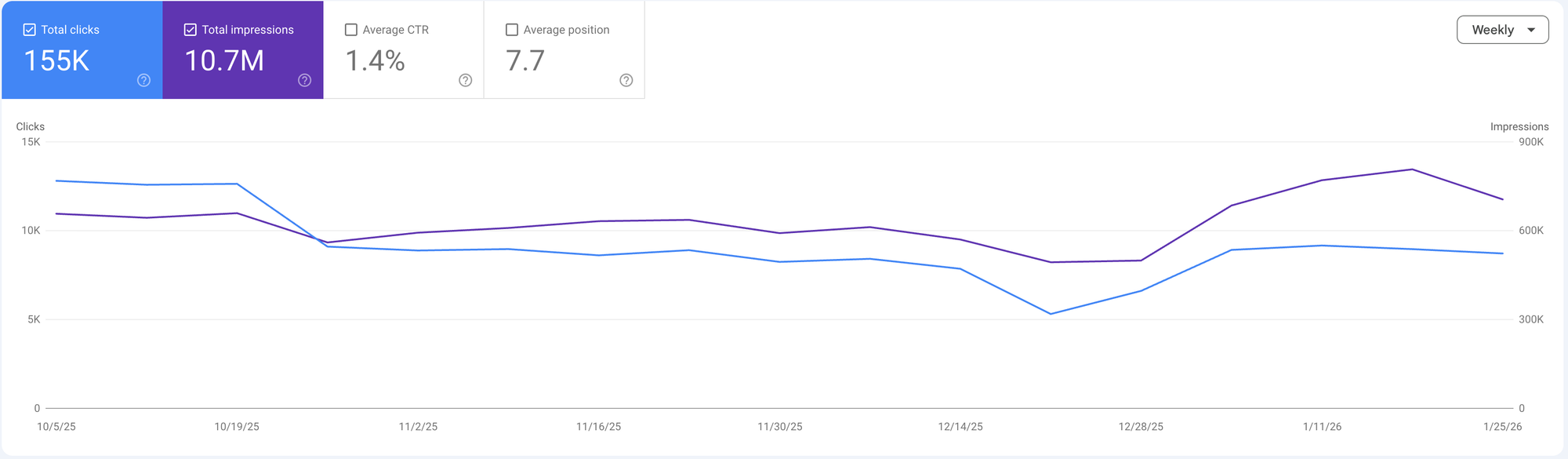
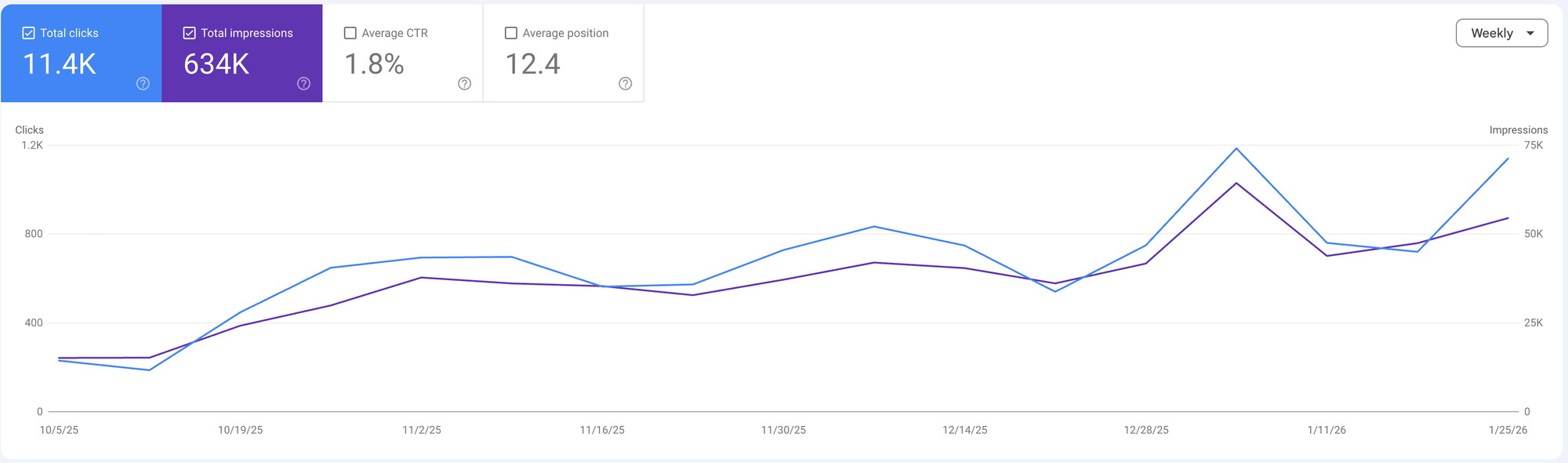
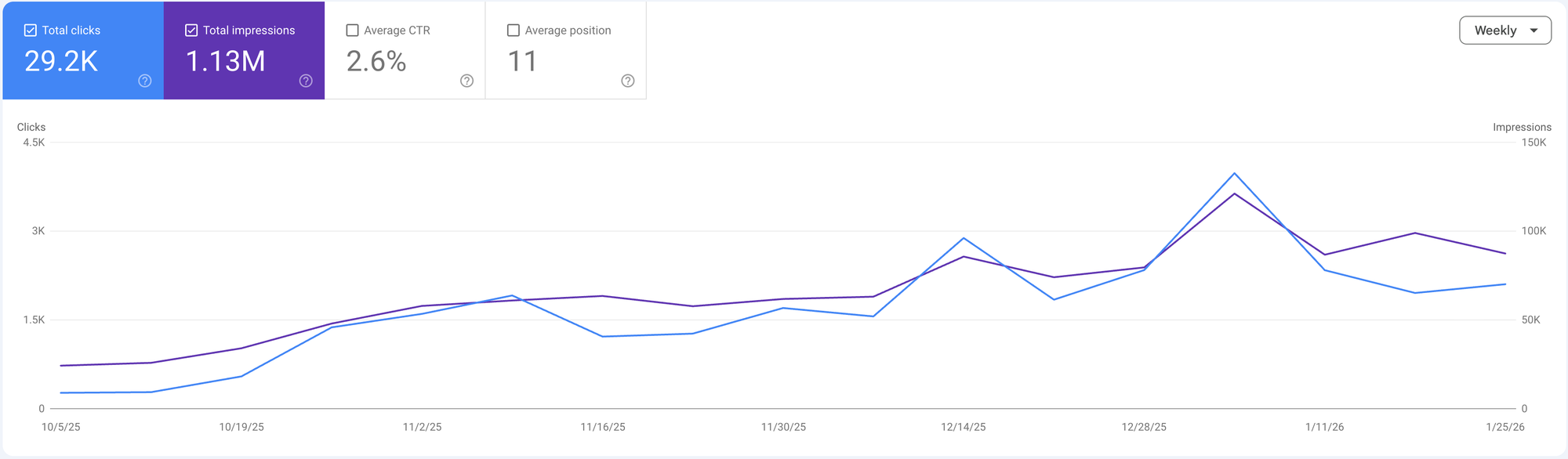
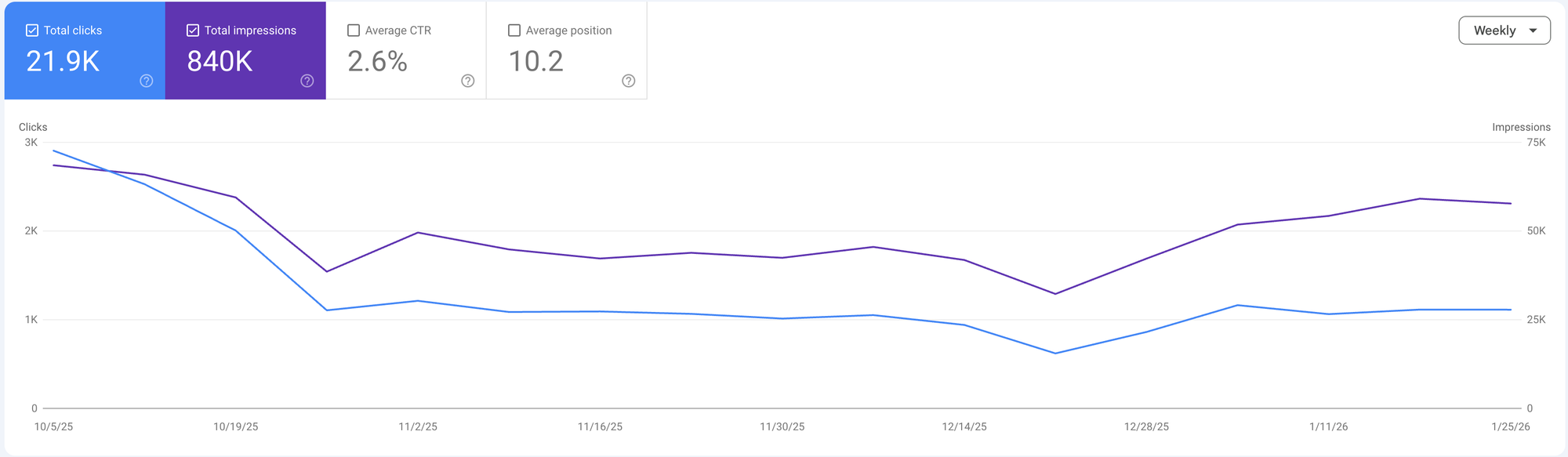
Across all four sites, we can see a clear upward trend emerging from late December onwards.
Nurses.co.uk and Healthcarejobs.ie had the most traffic to lose, and both experienced an immediate drop following the migration. In the case of Nurses.co.uk, this coincided with the deliberate removal of around 5,000 non-nursing jobs.
For Healthcarejobs.ie, more than half of its previous traffic originated from countries that were subsequently geo-blocked.
While both sites saw an initial decline, the charts show a clear recovery beginning around the new year.
In contrast, the impact on Socialcare.co.uk and Healthjobs.co.uk was immediate and positive, with search visibility improving almost straight away following the changes.
Looking at Google’s rolling 28-day comparison (January versus December), the overall trend is now positive. Most metrics are improving across all four sites, indicating that any short-term losses following the migration have been recovered and that search performance is now moving in the right direction:




How Has It Impacted Our Google Search Rank Performance?
To attract high-intent traffic from Google, we need to rank well for search queries that are genuinely relevant to health and social care jobseekers. Across our markets, there are approximately 2,500 core search phrases that candidates actively use, excluding long-tail variations such as location, contract type, or employer.
This is a highly competitive space, with major players such as Indeed and Stepstone investing heavily in search visibility. As a result, improving, and then sustaining, strong ranking positions is one of the most important levers in achieving our objective of increasing quality applications for our customers.
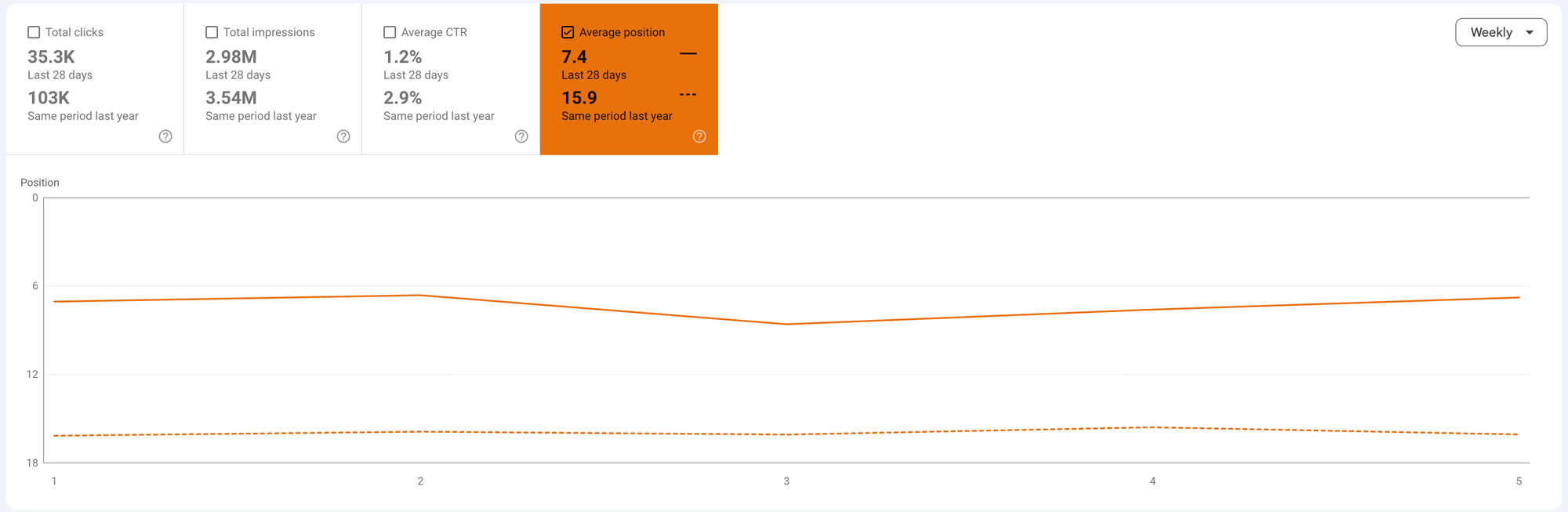
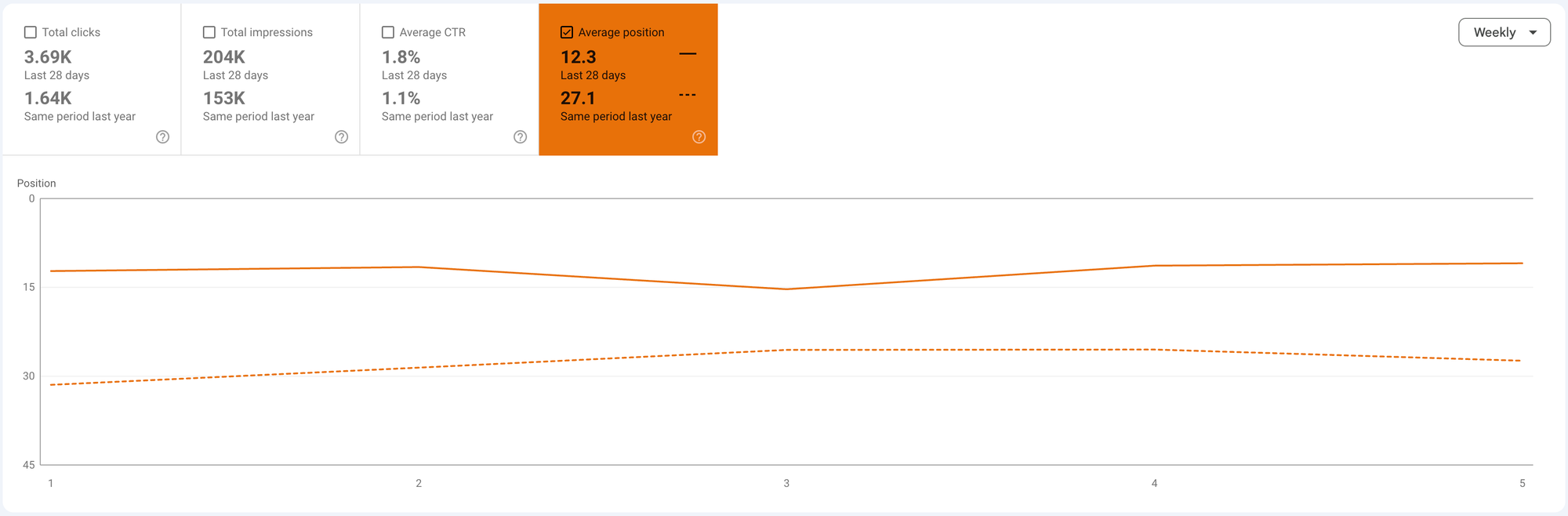
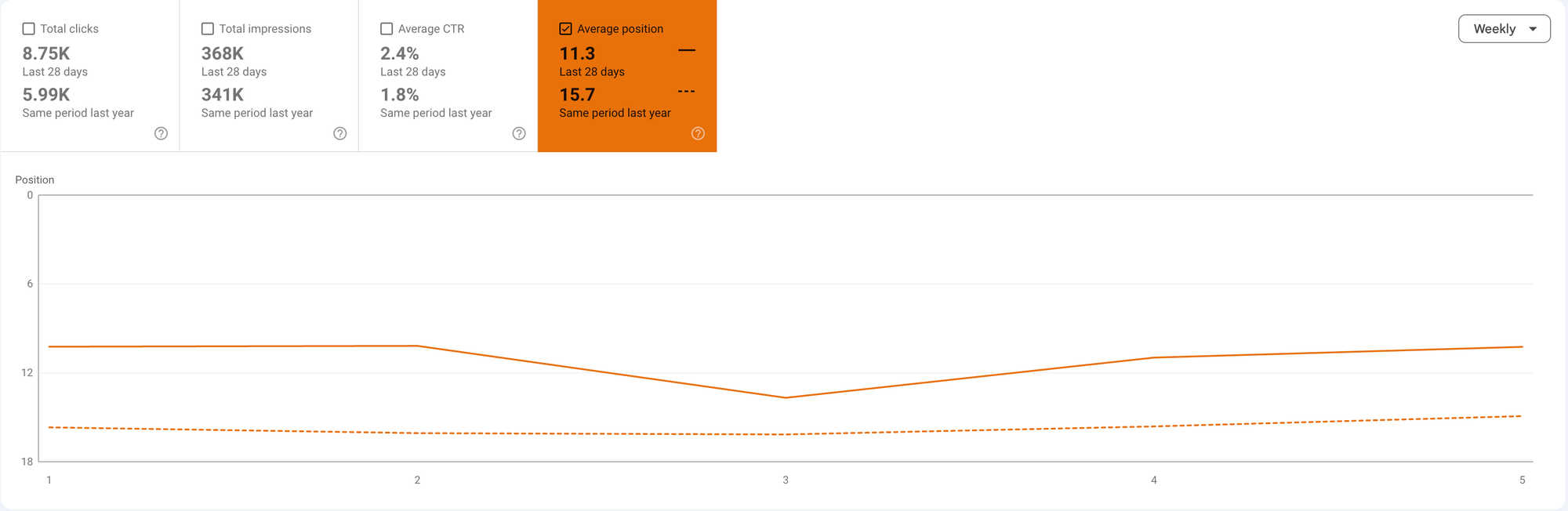
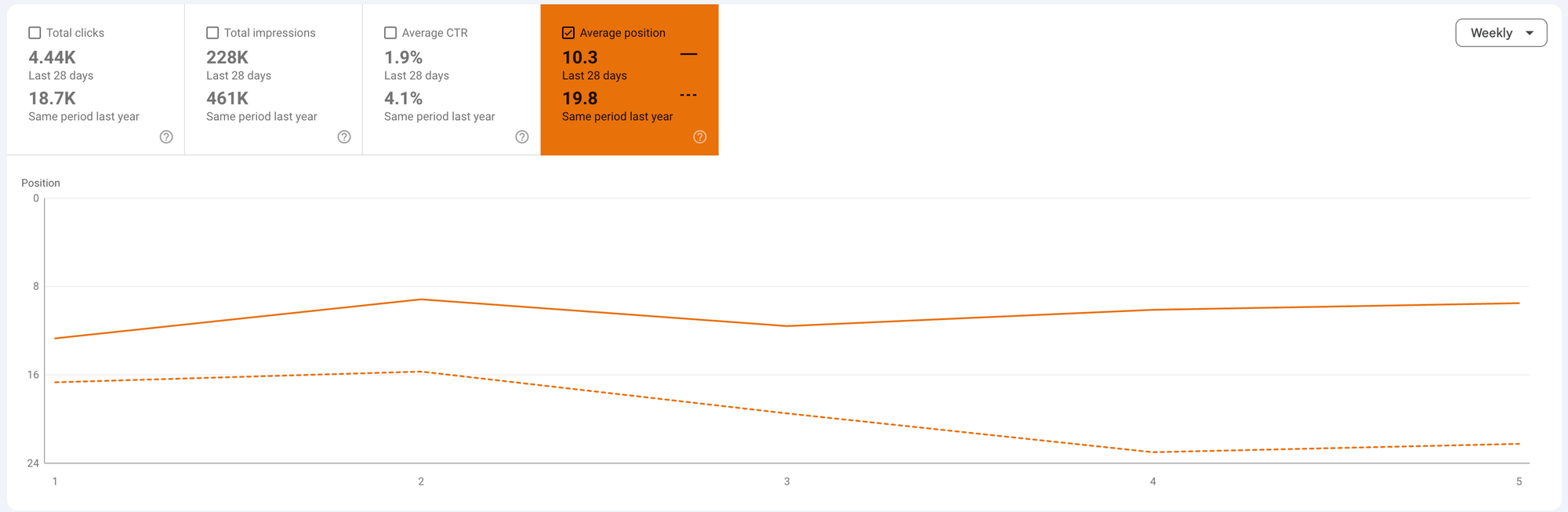
The charts below show our average Google Search position, comparing January 2025 (dotted line) with January 2026 (solid line). In every case, average ranking position has improved materially year on year.
The scale of that improvement is significant. As of February 8th 2026 we can look back and see that since October 23rd 2025:
- Nurses.co.uk has moved from 15.9 to an average Google position of 7.4
- Socialcare.co.uk from 27.1 to 12.3 average Google position
- Healthjobs.co.uk from 15.7 to 11.3 average Google position
- Healthcarejobs.ie has improved from 19.8 to 10.3 average Google position
These improvements indicate not just a recovery from the migration, but a structural strengthening of our visibility in Google search, particularly for commercially valuable, high-intent queries.
Context - Why Did We Make These Changes?
We introduced these changes because we believe the future of hiring will increasingly prioritise quality applications over volume clicks.
Much of the job board market is optimised around scale. Large platforms generate high volumes of traffic, supported by revenue models that reward clicks. While that approach can drive volume, it often creates downstream cost and inefficiency for talent acquisition teams, who then need to filter large numbers of low-quality or irrelevant applications.
Our objective is simpler and more focused: to increase the number of relevant, high-quality applications our customers receive. That principle guided each of the decisions below.
- Migration
We migrated to Jobiqo because its technology is purpose-built to perform well for both users and search engines. It is fast, has strong inherent SEO, and allowed us to properly structure and expand our taxonomy. Crucially, it also enabled us to integrate an AI-based job classifier (working with Alex Chukovski's Job Data Pipeline), ensuring every role is consistently categorised. This creates richer, more relevant pages. It is the kind of structure Google rewards, and supports our goal of attracting high-intent candidates through search.
- Geo-Blocker - why we cut off 82% of the world's users
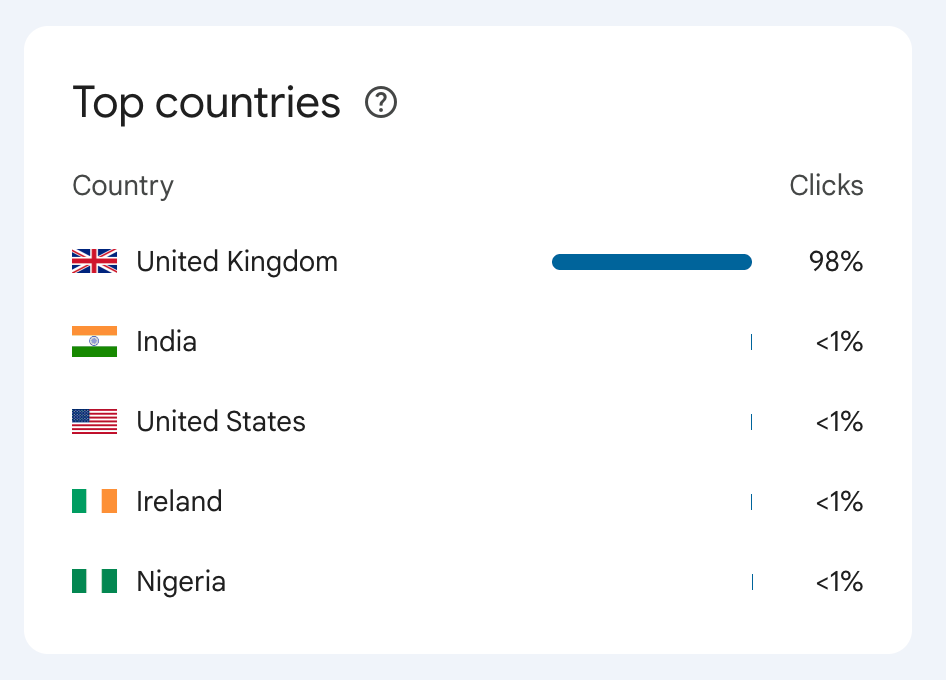
Changes in healthcare hiring, combined with government-level policy and compliance requirements, mean many employers cannot realistically process applications from most overseas locations, or offer sponsorships. If we are serious about relevance and quality, our traffic needs to reflect that reality. As a result, we removed access from most countries. Traffic to Nurses.co.uk is now 98% domestic.
- Siloed Jobs - why we shed 88% of Nurses.co.uk jobs overnight
Google does not reward duplicate content. Historically, we listed the same jobs across multiple sites, with Nurses.co.uk effectively acting as a catch-all. This caused Google to treat it as the canonical source, limiting the ability of our other specialist sites to grow.
To correct this, we removed all non-nursing roles from Nurses.co.uk in a single change on 23 October, reducing its job volume by 88%. This allowed each site to focus on its core audience and compete on its own merits in search. It was a risky move but we can see in the data that Google has not punished us.
- Remove jobseeker friction - why we chose applications over CVs
If our goal is to increase quality applications, we need to reduce unnecessary barriers in the application journey. We therefore removed the CV registration wall. This means capturing fewer CVs in our database, but it also reduces abandonment and leads to more completed applications. The improved user experience also reinforces our employer brand and trust with candidates.
Why Are We So Focused On Driving Applications From Google Search?
There are many ways a job board can acquire traffic. Our strategy is deliberately centred on search.
We prioritise Google because it consistently delivers high-intent candidates. A jobseeker using Google is actively searching, has a clearly defined need, and already understands the role and sector they are targeting. That intent translates into more relevant applications and better outcomes for employers.
Where Else Do We Get Traffic From?
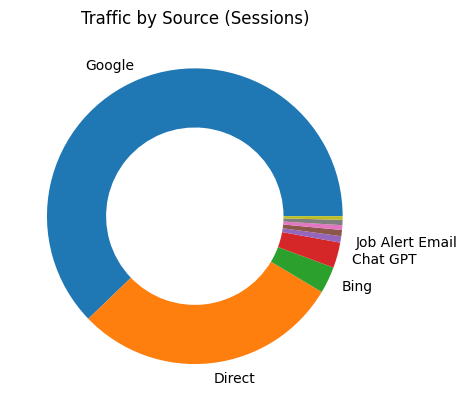
We do, of course, generate applications from other sources. Direct traffic remains significant, and we continue to invest in channels such as email and consider alternative search engines.
We also maintain a strong social media presence, with tens of thousands of followers across YouTube, Instagram, and Facebook. These channels play a brand and awareness role rather than acting as meaningful traffic / applicant drivers.
One notable development has been the rapid emergence of ChatGPT as an applicant referral source. While still relatively small in absolute terms, its growth has been surprisingly fast and is something we are monitoring closely.
We are also seeing early signs of visibility in other AI-driven discovery surfaces, including Gemini and Google’s AI Overviews, which suggests our content and structure are being surfaced in generative search experiences - but, like social media, these tend to not be applicant referral / transactional sources.
That said, Google remains by far the dominant driver of applications, accounting for the majority of our traffic. This reinforces our decision to focus on search visibility, relevance, and intent as the foundation of our growth strategy:
Contact me for more information
If you work in recruitment in healthcare or social care in the UK or Ireland and would like to talk, please email me at matt@nurses.co.uk.